
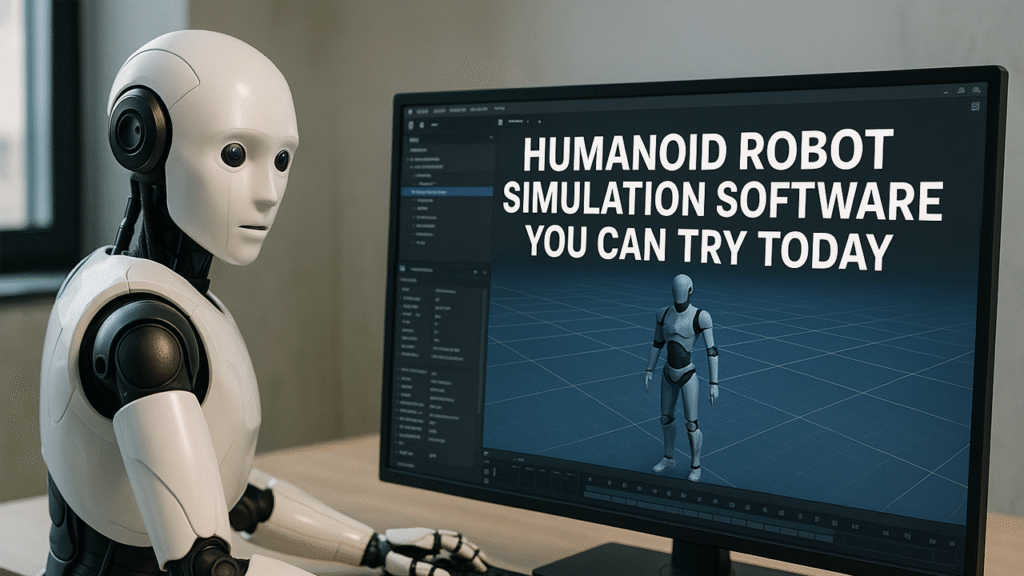
Humanoid Robot Simulation Software You Can Try Today
The world of humanoid robotics is advancing at an unprecedented pace, with innovations emerging almost daily. Whether you’re a robotics engineer, researcher, educator, or enthusiast, having access to quality simulation software is no longer a luxury—it’s a necessity. Simulation platforms allow you to test, refine, and perfect robotic systems before committing to expensive hardware deployments, saving time, money, and resources.
In this comprehensive guide, we’ll explore the best humanoid robot simulation software available today, discuss their features and applications, and explain how professional robotics consulting and recruitment services can accelerate your journey into the world of humanoid robotics.
Why Humanoid Robot Simulation Matters
Before diving into specific software platforms, it’s important to understand why simulation has become indispensable in humanoid robotics development.
Cost Efficiency: Physical humanoid robots can cost anywhere from tens of thousands to millions of pounds. Simulation software allows developers to experiment, fail, and iterate without the financial burden of damaging expensive hardware.
Safety: Testing new algorithms or behaviors on physical robots can pose risks to both the robot and surrounding personnel. Virtual environments provide a safe sandbox for experimentation.
Rapid Prototyping: Simulation accelerates the development cycle dramatically. What might take weeks to test on physical hardware can be accomplished in hours or days in simulation.
Accessibility: Not everyone has access to cutting-edge humanoid robots, but simulation software democratizes robotics development, making it accessible to students, researchers, and small businesses worldwide.
Complex Scenario Testing: Simulations can easily recreate scenarios that would be difficult, dangerous, or impossible to set up in the real world—from disaster response situations to zero-gravity environments.
Top Humanoid Robot Simulation Software Platforms
1. Gazebo
Gazebo has established itself as one of the most popular open-source robot simulation platforms in the robotics community. Originally developed by Willow Garage and now maintained by Open Robotics, Gazebo offers robust physics simulation and seamless integration with ROS (Robot Operating System).
Key Features:
- Realistic physics engines including ODE, Bullet, Simbody, and DART
- Extensive sensor simulation (cameras, LIDAR, IMUs, force-torque sensors)
- Large library of pre-built robot models, including popular humanoid platforms
- Plugin architecture for customization
- Support for both indoor and outdoor environments
Best For: Academic research, ROS-based development, and open-source projects
Getting Started: Gazebo is free and open-source. You can download it from gazebosim.org and find extensive tutorials and documentation online.
2. Webots
Developed by Cyberbotics, Webots is a professional mobile robot simulation software that has gained significant traction in both academia and industry. It provides a complete development environment for modeling, programming, and simulating robots.
Key Features:
- Comprehensive physics simulation with accurate dynamics
- Support for multiple programming languages (C, C++, Python, Java, MATLAB)
- Over 50 pre-configured robot models including several humanoid platforms
- Real-time simulation with 3D visualization
- Cross-platform compatibility (Windows, Linux, macOS)
Best For: Educational institutions, commercial applications, and multi-language development teams
Pricing: Webots offers a free open-source version since being acquired by Cyberbotics in 2018, making it accessible for most users.
3. V-REP (CoppeliaSim)
Now known as CoppeliaSim, V-REP is a powerful robot simulator with an integrated development environment. It stands out for its versatility and the ability to handle complex robotic systems.
Key Features:
- Eight different physics engines for specialized simulation needs
- Distributed control architecture allowing different programming approaches
- Extensive API supporting multiple languages
- Built-in path planning and inverse kinematics
- CAD data import for custom robot models
Best For: Complex multi-robot systems, research applications, and scenarios requiring multiple physics engines
Pricing: Offers both free educational licenses and commercial licenses depending on your use case.
4. MuJoCo
MuJoCo (Multi-Joint dynamics with Contact) has become increasingly popular, especially after DeepMind made it freely available in 2021. Originally developed for research and development in robotics and biomechanics, MuJoCo excels at simulating contact-rich behaviors.
Key Features:
- Fast and accurate physics simulation
- Optimized for reinforcement learning and control research
- Efficient contact dynamics
- Python bindings for easy integration with machine learning frameworks
- Active community and extensive model library
Best For: Machine learning research, reinforcement learning applications, and control algorithm development
Getting Started: MuJoCo is now free and open-source, available at mujoco.org with comprehensive documentation.
5. PyBullet
PyBullet is a Python interface for the Bullet Physics SDK, offering a straightforward approach to robot simulation with a focus on machine learning applications.
Key Features:
- Easy Python integration
- Fast physics simulation suitable for reinforcement learning
- OpenAI Gym integration
- VR support for immersive interaction
- Large collection of humanoid robot models
Best For: Python developers, machine learning practitioners, and reinforcement learning research
Pricing: Completely free and open-source, making it ideal for students and researchers.
6. NVIDIA Isaac Sim
NVIDIA’s Isaac Sim represents the cutting edge of robot simulation, leveraging the company’s expertise in graphics and AI to deliver photorealistic simulation environments.
Key Features:
- Photorealistic rendering using NVIDIA Omniverse
- GPU-accelerated physics simulation
- Integration with Isaac SDK for AI and perception
- Support for ROS and ROS2
- Realistic sensor simulation including cameras and LIDAR
- Synthetic data generation for training AI models
Best For: Computer vision applications, AI-powered robotics, and projects requiring photorealistic rendering
Pricing: Free for individual use, with enterprise options available for commercial deployments.
7. Unity ML-Agents with Humanoid Models
Unity, the popular game engine, has become a serious contender in robot simulation through its ML-Agents toolkit. While not exclusively for robotics, it offers powerful simulation capabilities for humanoid robots.
Key Features:
- Excellent graphics and rendering capabilities
- Strong reinforcement learning integration
- Active community and extensive asset store
- Cross-platform deployment
- VR and AR support for immersive experiences
Best For: Projects combining robotics with gaming technology, VR/AR applications, and visually impressive demonstrations
Pricing: Unity offers a free personal license, with paid options for larger organizations.
8. Choreonoid
Choreonoid is a comprehensive robotics simulation and modeling platform developed primarily in Japan. While less known internationally, it offers powerful features specifically tailored for humanoid robotics.
Key Features:
- Advanced dynamics simulation for legged robots
- Motion planning and trajectory optimization
- Integration with OpenRTM middleware
- Detailed collision detection
- Support for complex kinematic chains
Best For: Humanoid locomotion research, Japanese robotics projects, and OpenRTM-based systems
Getting Started: Choreonoid is open-source and available at choreonoid.org, though documentation is sometimes limited in English.
Specialized Humanoid Robot Simulation Tools
DART (Dynamic Animation and Robotics Toolkit)
DART is a collaborative open-source library that provides efficient forward and inverse dynamics, collision detection, and optimization. It’s often used as a physics engine within other simulation platforms.
OpenRAVE
While development has slowed, OpenRAVE remains relevant for motion planning research. It provides an environment for testing, developing, and deploying motion planning algorithms in real-world robotics applications.
RoboDK
RoboDK bridges the gap between simulation and real-world deployment, particularly for industrial applications. While primarily focused on industrial manipulators, it can handle humanoid upper-body manipulation tasks.
Choosing the Right Simulation Software
Selecting the appropriate simulation platform depends on several factors:
Your Technical Background: If you’re comfortable with Python and machine learning, PyBullet or MuJoCo might be ideal. For C++ developers, Gazebo or Webots could be better choices.
Project Requirements: Consider whether you need photorealistic rendering (Isaac Sim), fast physics for RL (MuJoCo), or comprehensive robotics features (Webots).
Integration Needs: If you’re working within the ROS ecosystem, Gazebo offers seamless integration. For machine learning frameworks, PyBullet or Isaac Sim might be preferable.
Budget: Most modern simulation platforms offer free options for academic or personal use, but commercial licenses may be required for business applications.
Community and Support: Established platforms like Gazebo and Webots have large communities, extensive documentation, and numerous tutorials—invaluable resources when you encounter challenges.
Real-World Applications of Humanoid Robot Simulation
Research and Development
Universities and research institutions worldwide use simulation software to develop novel locomotion algorithms, manipulation strategies, and human-robot interaction protocols. The ability to quickly iterate on ideas accelerates the pace of discovery.
Industrial Deployment Planning
Companies considering humanoid robot deployments use simulation to validate use cases before making substantial investments. Simulation helps answer critical questions: Can the robot navigate our facility? Will it reach necessary workspaces? How will it handle unexpected obstacles?
Education and Training
Educational institutions leverage simulation to teach robotics concepts without requiring expensive hardware for every student. Students can experiment freely, learning from failures without costly consequences.
Entertainment and Media
The entertainment industry uses humanoid robot simulation for virtual productions, character animation reference, and special effects planning, particularly when physical robots will appear in final productions.
Algorithm Development
Researchers developing new control algorithms, machine learning models, or perception systems rely heavily on simulation to validate their approaches before testing on physical hardware.
Integrating Simulation with Physical Robots
While simulation offers tremendous advantages, the ultimate goal is often deploying solutions on physical robots. The “sim-to-real gap” refers to differences between simulated and real-world performance.
Domain Randomization: Varying simulation parameters helps create models robust to real-world variations.
Realistic Physics: Using accurate mass properties, friction coefficients, and material properties narrows the sim-to-real gap.
Sensor Noise Modeling: Adding realistic sensor noise to simulations prepares algorithms for imperfect real-world data.
Progressive Testing: Start with simple tasks in simulation, validate on hardware, then gradually increase complexity.
Calibration: Use real-world data to fine-tune simulation parameters, improving fidelity.
The Future of Humanoid Robot Simulation
The field of robot simulation continues to evolve rapidly. Several trends are shaping its future:
Cloud-Based Simulation: Platforms like AWS RoboMaker enable large-scale parallel simulations in the cloud, accelerating development.
AI-Enhanced Simulation: Machine learning is being used to improve simulation accuracy and automatically generate realistic scenarios.
Digital Twins: Creating precise digital replicas of physical robots enables predictive maintenance and performance optimization.
Photorealistic Rendering: Advances in computer graphics are making simulations indistinguishable from reality, crucial for computer vision applications.
Haptic Integration: Emerging technologies allow developers to feel forces and interactions within simulations, improving teleoperation and training.
Getting Professional Support for Your Humanoid Robotics Project
While simulation software provides powerful tools, successfully deploying humanoid robotics solutions often requires specialized expertise. Whether you’re just beginning to explore humanoid robotics or scaling an existing deployment, professional guidance can dramatically accelerate your progress and avoid costly mistakes.
Expert Robotics Consulting
Navigating the complex landscape of humanoid robotics technology requires deep technical knowledge and practical experience. Professional robotics consultants bring:
- Technical Expertise: Years of hands-on experience with various humanoid platforms and simulation environments
- Strategic Planning: Help defining realistic project scopes, timelines, and budgets
- Technology Selection: Guidance choosing the right simulation software, hardware platforms, and integration approaches for your specific needs
- Custom Development: Assistance developing custom solutions, algorithms, and integrations
- Training: Comprehensive training programs to bring your team up to speed on humanoid robotics technologies
Robotics Recruitment Services
As humanoid robotics becomes increasingly sophisticated, finding qualified personnel with the right mix of skills becomes challenging. Specialized robotics recruitment services understand the unique requirements of robotics projects:
- Specialized Talent Pool: Access to engineers, researchers, and technicians with proven humanoid robotics experience
- Technical Screening: Proper evaluation of candidates’ technical capabilities specific to humanoid robotics
- Project-Based Staffing: Flexible arrangements from short-term consulting to permanent placements
- Skills Assessment: Understanding whether candidates have experience with specific simulation platforms, control systems, or AI frameworks
Why Professional Services Matter
Many organizations underestimate the complexity of humanoid robotics projects. Common challenges include:
- Unrealistic expectations about robot capabilities
- Underestimating integration complexity
- Inadequate testing and validation processes
- Insufficient consideration of safety requirements
- Poor project management and timeline planning
Professional consulting and recruitment services help organizations avoid these pitfalls, saving time and money while increasing the likelihood of successful deployment.
Taking the Next Step
Ready to advance your humanoid robotics project? Whether you need simulation software guidance, implementation support, or specialized talent, professional services can provide the expertise you need.
Contact Information:
- Email: SALES@ROBOTSOFLONDON.CO.UK
- Phone: 0845 528 0404
Schedule a consultation to discuss your specific needs, explore how simulation can benefit your project, and learn how professional consulting and recruitment services can accelerate your success in humanoid robotics.
Practical Tips for Getting Started
Start Small: Begin with simple simulation tasks before tackling complex scenarios. Master basic robot control before implementing advanced AI algorithms.
Leverage Tutorials: Most simulation platforms offer excellent tutorials. Work through these systematically to build foundational skills.
Join Communities: Participate in forums, Discord servers, and online communities dedicated to your chosen simulation platform. The collective knowledge of these communities is invaluable.
Contribute Back: If you develop useful tools, models, or documentation, consider sharing them with the community. This collaboration accelerates progress for everyone.
Document Everything: Keep detailed notes on your simulation parameters, challenges encountered, and solutions discovered. This documentation becomes invaluable as projects grow in complexity.
Validate Regularly: Periodically test your simulated algorithms on physical hardware, even if it’s just a simple robot. This helps maintain awareness of the sim-to-real gap.
Stay Updated: The field moves quickly. Follow key researchers, join mailing lists, and attend conferences (virtual or in-person) to stay current with the latest developments.
Conclusion
Humanoid robot simulation software has matured to the point where sophisticated robotics development is accessible to anyone with dedication and a computer. From free, open-source platforms like Gazebo and PyBullet to commercial solutions like NVIDIA Isaac Sim, there’s a simulation environment suited to virtually any project requirement or skill level.
The key is to start. Choose a platform that aligns with your technical background and project goals, work through tutorials, and begin experimenting. The democratization of robotics through simulation means that breakthrough innovations can come from anywhere—including your next project.
Remember that while simulation is powerful, real-world deployment presents unique challenges. Professional consulting services can help bridge the gap between simulation and reality, providing the expertise needed to successfully deploy humanoid robotics solutions in commercial, industrial, or research settings. Similarly, finding the right talent through specialized recruitment services ensures your team has the skills necessary to execute ambitious robotics projects.
The future of humanoid robotics is being built today, in simulations running on computers around the world. With the tools and resources now available, that future is accessible to you. Start exploring, experimenting, and building—the possibilities are limited only by your imagination.
For organizations serious about humanoid robotics, combining cutting-edge simulation tools with professional expertise creates a powerful foundation for success. Whether you’re developing the next generation of service robots, conducting groundbreaking research, or implementing robots in commercial settings, the journey begins with taking that first step.
Get in touch today to explore how professional robotics consulting and recruitment services can transform your humanoid robotics vision into reality.
Article Sponsors
This article is brought to you by leaders in the robotics industry:
Robot Center – Your comprehensive source for robot purchase, robot buying services, and expert robotics consultancy. Whether you’re looking to acquire cutting-edge robotic systems or need strategic guidance on robotics implementation, Robot Center provides end-to-end solutions for businesses entering the robotics space.
Robots of London – Specialists in robot hire, robot rental, and robot event services. From short-term robot rentals for special events to long-term hire arrangements for business applications, Robots of London makes advanced robotics accessible and affordable. Perfect for testing humanoid robots before purchase or creating unforgettable experiences at events.
Robot Philosophy (RoboPhil) – Led by Philip English, a renowned robot YouTuber, robot influencer, robot trainer, robot consultant, and robotics streamer, Robot Philosophy offers expert robot consultancy and specialized robot recruitment services. With deep industry insights and extensive practical experience, RoboPhil provides robot advice, robotics insights, and innovative robot ideas to help organizations navigate the complex world of humanoid robotics. As a leading robotics influencer and consultant, Philip English brings unparalleled expertise to every engagement.
The simulation revolution in humanoid robotics is here. The question isn’t whether to embrace it, but how quickly you can get started. Choose your platform, reach out for expert guidance if needed, and begin building the future today.
https://www.youtube.com/watch?v=k86hZOVtzDs