
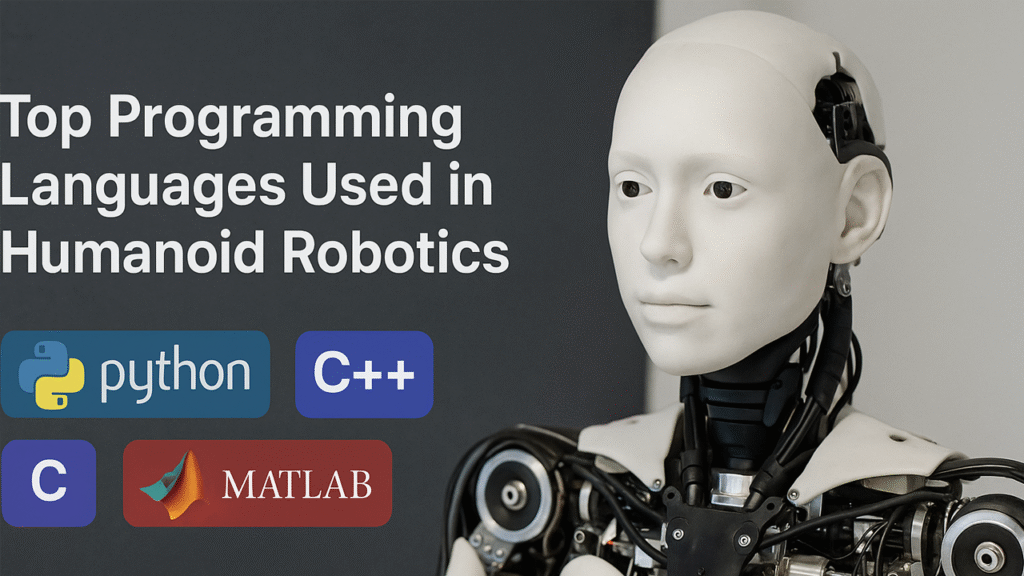
Top Programming Languages Used in Humanoid Robotics
Humanoid robotics is no longer a concept confined to science fiction—it is a living, breathing industry that is reshaping how humans and machines interact. From hospitality robots greeting guests to industrial humanoids performing precision tasks, humanoid robotics is bridging the gap between mechanical automation and human-like intelligence.
Behind these machines lies the invisible architecture of software. Programming languages are the foundation of humanoid robotics, enabling robots to perceive their environment, process data, make decisions, and act in real time. Choosing the right programming language is crucial, as it directly influences a robot’s efficiency, adaptability, and long-term performance.
In this in-depth article, we will explore the top programming languages used in humanoid robotics, why they matter, and how businesses can leverage this knowledge to stay ahead of the curve. Whether you’re an SME exploring automation, a researcher building prototypes, or a corporation planning large-scale robot deployment, understanding programming languages in humanoid robotics is essential for making informed decisions.
👉 For businesses ready to explore how humanoid robots can fit into their strategy, visit Humanoid Robot Solutions.
1. Why Programming Matters in Humanoid Robotics
Programming is the nervous system of robotics. While hardware provides the muscles, motors, and sensors, programming languages provide the intelligence that controls everything.
Movement: Languages control servo motors, actuators, and joint systems.
Perception: They process data from cameras, LiDAR, microphones, and touch sensors.
Decision-Making: Algorithms allow robots to evaluate scenarios and choose appropriate actions.
Human-Robot Interaction (HRI): Natural language processing and AI frameworks enable humanoids to understand and respond to human speech, gestures, and behavior.
Connectivity: Programming allows humanoids to integrate with IoT systems, cloud platforms, and business software.
Without the right programming language, a humanoid robot may lack speed, accuracy, or adaptability. The following sections detail the languages driving humanoid robotics today.
2. C and C++ – The Backbone of Robotics
When it comes to humanoid robotics, C and C++ are industry staples.
Why C/C++?
Performance: Humanoid robots require real-time processing for tasks like walking, balancing, and object manipulation. C++ provides the raw speed to handle these demands.
Hardware Access: These languages allow direct interaction with hardware components such as sensors and actuators.
ROS Compatibility: The Robot Operating System (ROS)—the standard middleware for robotics—is primarily written in C++ and Python, making C++ essential for developers.
Real-World Applications
Motion Planning: C++ algorithms ensure humanoids walk smoothly and avoid obstacles.
Sensor Integration: Cameras, gyroscopes, and force sensors are often coded at the C/C++ level.
Embedded Systems: Many humanoids rely on microcontrollers programmed in C for precise motor control.
👉 Businesses that want humanoid robots with high-performance motion and embedded systems should consult with experts. Book a robot consulting session via SALES@ROBOTSOFLONDON.CO.UK or call 0845 528 0404.
3. Python – The AI and Machine Learning Powerhouse
Python is the most popular language for AI-driven humanoids.
Why Python?
AI & Machine Learning: Frameworks like TensorFlow, PyTorch, and scikit-learn run on Python.
Ease of Use: Python’s simple syntax makes it ideal for rapid prototyping.
ROS Integration: Alongside C++, Python is the second most important ROS language.
Real-World Applications
Computer Vision: Python powers OpenCV and deep learning models for humanoid vision.
Natural Language Processing (NLP): Voice-enabled humanoids use Python libraries for speech recognition and dialogue.
Predictive Maintenance: Machine learning algorithms predict hardware failures before they occur.
Humanoid robots that greet, guide, and interact with humans in hospitality, retail, or healthcare are often running Python AI models behind the scenes.
4. Java – For Cross-Platform Robotics
Java has long been a staple in enterprise computing, and its features make it well-suited for humanoid robotics.
Why Java?
Cross-Platform Support: Java applications run across different operating systems without modification.
Large Ecosystem: Libraries like JavaFX and third-party robotics APIs enhance flexibility.
AI Integration: Java supports AI frameworks and neural networks.
Real-World Applications
Educational Humanoids: Many academic humanoid robot projects use Java for teaching robotics.
Enterprise Robotics: Companies integrating humanoids into existing IT systems often rely on Java for compatibility.
Java may not control the robot’s motors directly, but it plays a key role in higher-level business integration.
5. MATLAB – The Engineering and Research Tool
MATLAB is widely used in robotics research, particularly for humanoids requiring complex simulations.
Why MATLAB?
Simulation Power: Allows engineers to model humanoid walking, balancing, and arm trajectories.
Control Systems: Advanced mathematical tools for PID controllers and state-space models.
AI & Robotics Toolbox: Built-in libraries support robotics algorithms.
Real-World Applications
Prototyping: Before humanoids are built, MATLAB simulates their movements.
University Research: Most academic humanoid studies involve MATLAB at some stage.
Optimization: Fine-tuning humanoid walking algorithms to reduce energy consumption.
While not always deployed in the final robot, MATLAB accelerates innovation cycles in humanoid robotics.
6. JavaScript – For Web-Integrated Humanoids
With humanoids increasingly acting as interactive kiosks in retail and hospitality, JavaScript has entered the robotics space.
Why JavaScript?
Web Interfaces: JavaScript allows humanoids to run browser-based applications.
Node.js: Used for controlling robots via event-driven programming.
Cross-Device Communication: Enables humanoids to sync with mobile apps, websites, and databases.
Real-World Applications
Retail Robots: JavaScript powers humanoids that display menus, products, and advertisements.
Interactive Events: Event-based humanoids use JavaScript for touchscreen and voice interfaces.
IoT Integration: Connecting humanoids to cloud services and smart environments.
For event robots and customer-facing humanoids, JavaScript is often the bridge between the robot and the end-user.
7. Lisp and Prolog – AI Pioneers in Robotics
Although less mainstream today, Lisp and Prolog still influence humanoid robotics, especially in cognitive robotics research.
Lisp: Known for its symbolic processing, useful in AI reasoning.
Prolog: Used for logic programming and decision-making.
These languages are particularly strong in robot planning and reasoning, though often paired with modern languages like Python.
8. Rust – The Future of Safe Robotics Programming
Rust is gaining traction in robotics due to its memory safety and concurrency features.
Why Rust?
Safety First: Prevents memory leaks and crashes that could endanger humanoid performance.
Concurrency: Handles multiple processes, ideal for humanoids performing complex tasks simultaneously.
Community Growth: Increasing adoption in embedded and robotics systems.
Rust is still new in humanoid robotics, but it may soon rival C++ for safety-critical applications.
9. Combining Languages – Multi-Layered Robotics Software
In reality, humanoid robots rarely rely on a single programming language. Instead, developers combine several languages depending on the task:
C/C++: For motor control and real-time systems.
Python: For AI, ML, and perception.
Java/JavaScript: For enterprise integration and user interfaces.
MATLAB: For simulation and research.
This layered approach allows humanoid robots to be fast, intelligent, and interactive at the same time.
10. Choosing the Right Language for Your Humanoid Robot
The choice of language depends on:
Application: Is the humanoid for research, industry, or customer-facing roles?
Hardware: Does it run on microcontrollers, PCs, or cloud-based systems?
Integration Needs: Will it connect to enterprise systems or stand alone?
Future Scalability: Can the software be updated and expanded easily?
This is where robot consultancy becomes vital. Without expert advice, businesses may choose the wrong language or system, resulting in wasted investment.
👉 Book a robot consulting session today at SALES@ROBOTSOFLONDON.CO.UK or call 0845 528 0404 to avoid costly mistakes and ensure your humanoid robotics project succeeds.
11. The Business Case for Humanoid Robotics
Humanoid robotics is not just about engineering—it’s about business transformation.
Hospitality: Robots greet, serve, and guide customers.
Healthcare: Humanoids provide patient support and companionship.
Retail: Robots act as sales assistants and advertising platforms.
Education: Humanoids support teaching and training.
Programming languages are the tools that make these real-world benefits possible. Companies that understand the software side gain a competitive advantage in deploying humanoids effectively.
12. Upselling Services – Why Work With Us
At Robots of London, we don’t just supply humanoid robots—we provide end-to-end consulting and recruitment services that help businesses choose, implement, and manage robots effectively.
Robot Consulting: Tailored advice on the best programming languages, platforms, and humanoid models for your needs.
Robot Recruitment: We help you find the right robotics professionals to run your projects.
📩 Email us today at SALES@ROBOTSOFLONDON.CO.UK or 📞 call 0845 528 0404 to book a session.
13. Sponsors of This Article
This article is proudly sponsored by:
Robot Center – Buy Robot, Robot Buy, Robot consultancy, Robotics Consultancy
Robots of London – Robot Hire, Robot Rental, Rent Robot, Hire Robot, Robot Events
Robot Philosophy – Robot Consultancy AND Robot Recruitment, Robot Advice, Robot Insights, Robot Ideas. RoboPhil (Philip English) is a leading Robot YouTuber, Robot Influencer, Robot Trainer, Robot Consultant, and Robot Streamer.
14. Final Thoughts
Humanoid robotics is advancing rapidly, and programming languages are the key drivers of this evolution. From the speed of C++ to the AI power of Python, the integration capabilities of Java, and the future potential of Rust, the software layer defines what humanoid robots can achieve.
For businesses, understanding these languages isn’t just a technical curiosity—it’s a strategic advantage. By partnering with experts who know the strengths and limitations of each programming language, companies can future-proof their investment in humanoid robotics.
👉 Don’t navigate this complex field alone. Contact Robots of London today for consulting and recruitment services at SALES@ROBOTSOFLONDON.CO.UK or call 0845 528 0404 to book your consultation.
Humanoid robotics is here. The question is: will your business be ready to lead the future?
https://www.youtube.com/watch?v=eiVYu2l3OqQ